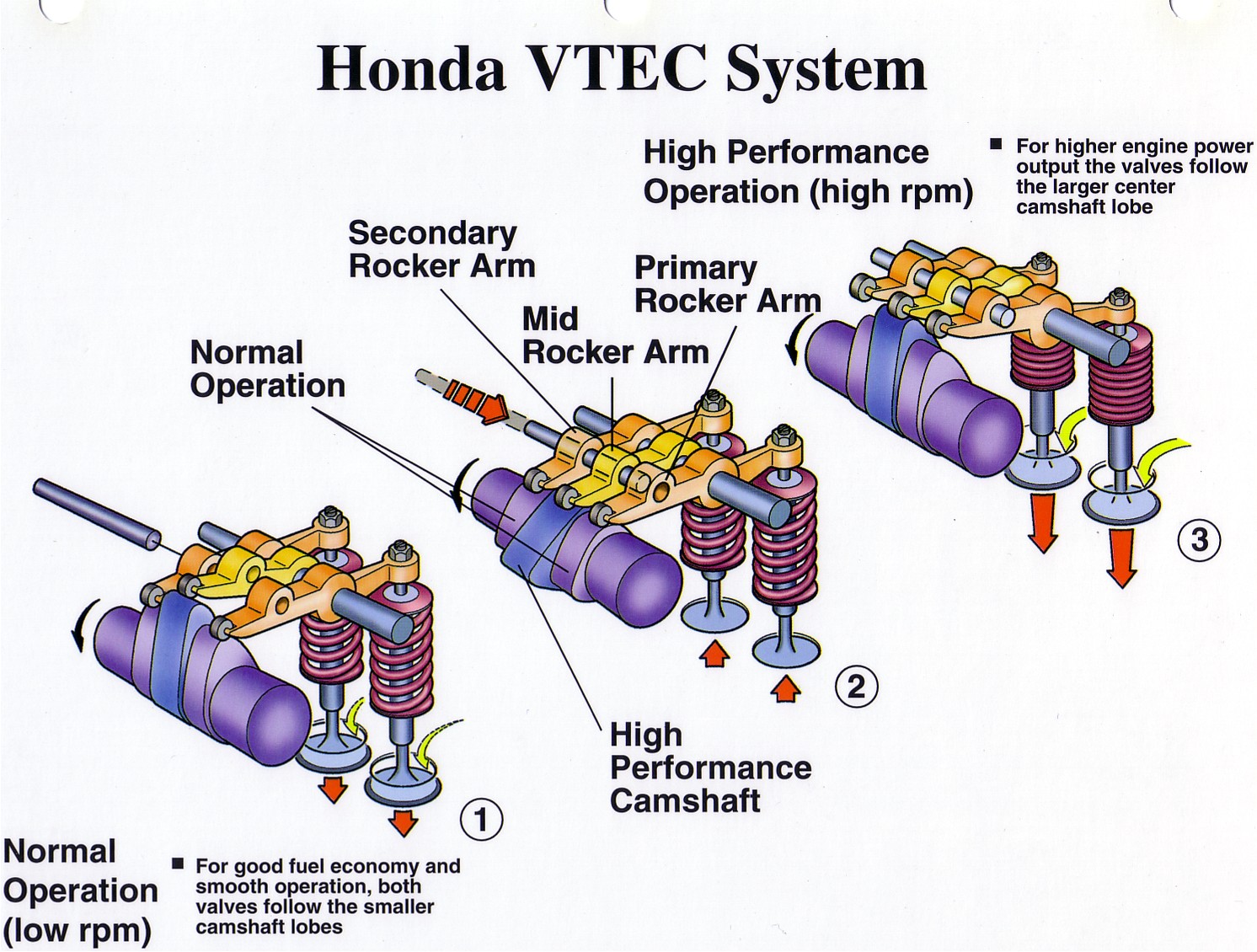
VTEC (Variable Valve Timing and Lift Electronic Control)
General Explanation:
VTEC, which stands for Variable Valve Timing and Lift Electronic Control, is an innovative technology developed by Honda to enhance the performance and efficiency of their internal combustion engines. The primary goal of VTEC is to optimize the engine's volumetric efficiency, which refers to the ability of the engine to fill its cylinders with air and fuel. By doing so, VTEC helps improve fuel economy, increase power output, and reduce emissions.
The VTEC system operates by using two different camshaft profiles—one for low RPM (revolutions per minute) and another for high RPM. At lower engine speeds, the engine uses a cam profile designed for efficiency, providing better fuel economy and smoother operation. As the engine speed increases, the system hydraulically switches to a more aggressive cam profile that allows for greater lift and duration of the intake and exhaust valves. This transition enables the engine to produce more power without sacrificing efficiency at lower speeds.
The VTEC system is controlled electronically, allowing for precise timing of the switch between cam profiles. This technology is particularly beneficial in performance-oriented vehicles, where drivers demand both power and efficiency. VTEC has become a hallmark of Honda's engineering prowess and is often associated with their high-performance models.
Technical Explanation
Common Symptoms of VTEC Issues:
- Check Engine Light: If the VTEC system is malfunctioning, it may trigger the check engine light on the dashboard.
- Loss of Power: Drivers may notice a significant drop in power, especially at higher RPMs, indicating that the VTEC system is not engaging properly.
- Poor Fuel Economy: A malfunctioning VTEC can lead to decreased fuel efficiency, as the engine may not be operating at its optimal profile.
- Rough Idle or Engine Hesitation: The engine may exhibit rough idling or hesitation during acceleration if the VTEC system is not functioning correctly.
- Unusual Engine Noise: Some drivers may hear abnormal sounds from the engine, particularly when the VTEC system is supposed to engage.
Diagnosing VTEC Issues:
- OBD-II Scanner: Use an On-Board Diagnostics II (OBD-II) scanner to check for any trouble codes related to the VTEC system. Codes such as P1259 (VTEC malfunction) can indicate specific issues.
- Visual Inspection: Inspect the VTEC solenoid and associated wiring for any signs of damage, leaks, or corrosion.
- Oil Level and Quality: Check the engine oil level and quality, as low or dirty oil can affect the VTEC system's operation. VTEC systems rely on proper oil pressure to function correctly.
- Testing the VTEC Solenoid: The VTEC solenoid can be tested for proper operation by applying voltage and checking for movement. If it fails to engage, it may need replacement.
- Camshaft Profile Check: In some cases, a mechanic may need to inspect the camshaft profiles to ensure they are in good condition and functioning as intended.
Common Repairs for VTEC Issues:
- VTEC Solenoid Replacement: If the solenoid is found to be faulty, replacing it is a common repair that can restore proper function to the VTEC system.
- Oil Change: If the oil is dirty or low, a simple oil change may resolve issues related to VTEC performance.
- Wiring Repairs: Repairing or replacing damaged wiring or connectors associated with the VTEC system can help restore functionality.
- Camshaft Replacement: In cases where the camshaft profiles are worn or damaged, replacing the camshaft may be necessary.
- Engine Control Unit (ECU) Reprogramming: If the ECU is not properly communicating with the VTEC system, reprogramming or updating the ECU may be required.
By understanding the VTEC system and its components, drivers can better diagnose and address issues that may arise, ensuring their Honda vehicles continue to perform efficiently and powerfully.