P0325 2000 Toyota Camry Code - Knock Sensor Circuit Malfunction
Quick Answer
The Knock Sensor (KS) senses engine knocking (also known as detonation or pinging) using a piezoelectric element. Common causes include Faulty Knock Sensor, Knock Sensor circuit poor electrical connection, Knock Sensor harness is open or shorted. Severity is High - diagnose this code as soon as possible. Driving is not recommended if the warning light is flashing, the engine runs poorly, or safety-related symptoms are present.
- What it means
- P0325 2000 Toyota Camry indicates Knock Sensor Circuit Malfunction.
- Common causes
- Common causes include Faulty Knock Sensor, Knock Sensor circuit poor electrical connection, Knock Sensor harness is open or shorted.
- Severity
- High - diagnose this code as soon as possible.
- Can I drive?
- Driving is not recommended if the warning light is flashing, the engine runs poorly, or safety-related symptoms are present.


Code P0325 2000 Toyota Camry Description

What are the Possible Causes of the DTC P0325 2000 Toyota Camry?
- Faulty Knock Sensor
- Knock Sensor circuit poor electrical connection
- Knock Sensor harness is open or shorted
- Faulty Engine Control Module (ECM)
How to Fix the DTC P0325 2000 Toyota Camry?
Review the 'Possible Causes' above and visually examine the corresponding wiring harness and connectors. Check for damaged components and inspect connector pins for signs of being broken, bent, pushed out, or corroded.
Code Tech Notes
What is the Cost to Diagnose the Code?
Labor: 1.0
To diagnose the P0325 2000 Toyota Camry code, it typically requires 1.0 hour of labor. Rates vary by location, vehicle, and shop. Many shops charge between $80–$150 per hour; dealerships and metro areas may be higher, independents may be lower.
Need more information about the P0325 2000 Toyota Camry code?
Need more information on how to fix the P0325 2000 Toyota Camry code? Get Access to Factory Service Manuals
Need Help with the Code?
Get the P0325 2000 Toyota Camry code diagnosed by a professional: Find a repair shop in your area
Frequently Asked Questions about P0325 2000 Toyota Camry Code
1. What are the common symptoms of OBDII code P0325 in a 2000 Toyota Camry?
- Common symptoms include reduced engine performance, knocking noises from the engine, and potential stalling or hesitation during acceleration.
2. What causes the Knock Sensor Circuit Malfunction in a 2000 Toyota Camry?
- The primary cause is typically a faulty knock sensor, wiring issues in the knock sensor circuit, or a problem with the engine control module (ECM).
3. How does the knock sensor function in a 2000 Toyota Camry?
- The knock sensor detects abnormal engine vibrations or knocking sounds, signaling the ECM to adjust ignition timing for optimal performance and to prevent engine damage.
4. Can driving with OBDII code P0325 harm the engine of a 2000 Toyota Camry?
- While driving with this code may not immediately cause severe damage, it can lead to decreased fuel efficiency and long-term engine issues if left unresolved.
5. How can I diagnose the Knock Sensor Circuit Malfunction in my 2000 Toyota Camry?
- Diagnosing P0325 typically involves using a scan tool to read the code, testing the knock sensor and related wiring for continuity and resistance, and checking the ECM for proper functioning.
6. Is it possible to reset the OBDII code P0325 in a 2000 Toyota Camry without fixing the issue?
- Resetting the code without addressing the underlying problem will only temporarily clear the error code, as it will likely reappear once the ECM detects the same issue again.
7. Can I replace the knock sensor in my 2000 Toyota Camry myself?
- While it is possible to replace the knock sensor yourself, it is recommended to consult a professional mechanic for proper diagnosis and repair to ensure the issue is resolved correctly.
8. Are there any preventive measures to avoid OBDII code P0325 in a 2000 Toyota Camry?
- Regular maintenance, such as checking and replacing worn-out sensors and ensuring proper engine operation, can help prevent issues like the Knock Sensor Circuit Malfunction.
9. Will fixing OBDII code P0325 improve the overall performance of a 2000 Toyota Camry?
- Resolving the Knock Sensor Circuit Malfunction can lead to improved engine performance, better fuel efficiency, and smoother operation of the vehicle.
10. How long does it typically take to repair OBDII code P0325 in a 2000 Toyota Camry?
- The repair time for fixing P0325 can vary depending on the exact cause of the issue, but it usually takes a few hours to diagnose and replace the knock sensor or repair wiring problems.
Discuss the causes and fixes for P0325 2000 Toyota Camry OBDII Code
-
obdii failed when I was having a smog check. Message said not ready.Technition said I needed to drive more miles. How many miles are required and do the miles have to be done all at once? Sensor an module was replaced
-
It all depends how you drive and the speed. The idea is to drive normal conditions so the vehicle's computer have enough time to check all the sensors. 10-20 min at freeway speeds and 10-20 min street driving should be enough. Make sure the fuel tank is at least half full.
-
I have a 2000 Toyota camry 3.0l with codes PO325 and PO330 that keep coming back on soon after I clear the system. I replaced both knock sensors with a new harness and the problem still keeps coming back.
-
Any driveability problems or other symptoms? If you have no other symptoms, the the next step is to check the wires from the sensor to the Engine Control Module (ECM), if the wires are OK, then you may have a problem withe the ECM. As you can see on the attached diagram, there is nothing else between the ECM and sensors.
-
I have the same vehicle and struggling to find both sensors location is you can help
-
The air intake chamber and intake manifold must be removed for access to knock sensors.

Click here to enlarge imageThe knock sensors are on top of the engine block.
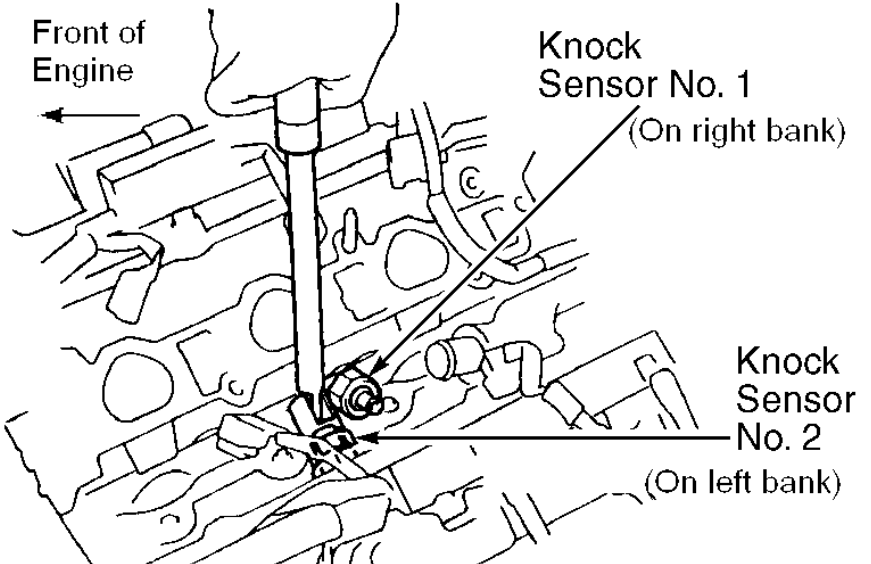
Click here to enlarge image -
I have p0325,p0172,p0105 and p0106 along with red exhaust manifold in my 2000 toyota camry. Idle speed is 1600 in park mode. Inability to accelerate sometime. Black exhaust smoke... Advise will be appreciated.
-
Sounds like all the code you have are the result of the problem, and the components that the codes represent are not the problem. The P0172 code means that the engine is running very rich (too much gas) which may trigger the other codes and turn the manifold red. Very rich system is usually cause by leaking fuel injector (s) or bad spark plugs. Since the spark plugs are part of the maintenance and easier to replace, you should start with that. Also try no to run the engine in that condition, it will damage the catalytic converter and other engine parts.

Fix Your Car Smarter
Try the New AutoCodes App!
Get complete OBDII diagnostics, repair solutions, and cost estimates, plus AI chat support on demand.
